
The dining table is the center of gravity in every household. Indeed, this is where families gather, share stories, and enjoy daily meals. Therefore, choosing a premium quality dining table is not just about aesthetics, but rather a long-term investment in comfort. Unfortunately, many retail consumers feel disappointed when they find their table tops starting to warp or crack after just a few months of use. One of the main causes of this damage is the buyer’s lack of knowledge regarding technical material specifications. In reality, the ultimate secret to a sturdy and durable table lies in the solid wood thickness used. Thus, this article will scientifically and professionally dissect the ideal thickness standards you absolutely must know before deciding to shop for new furniture.
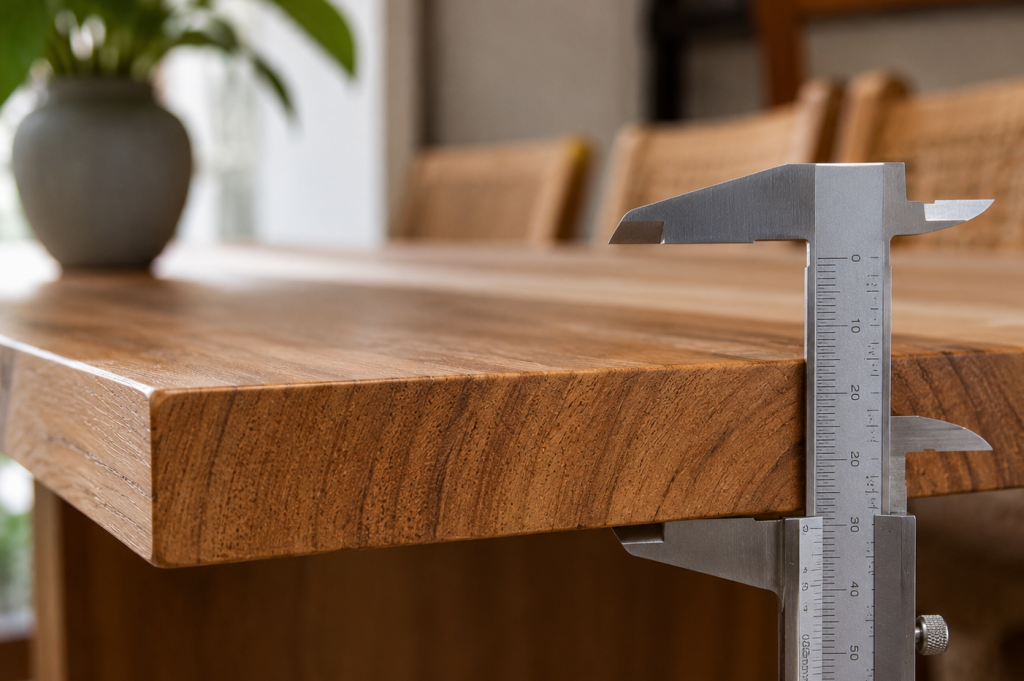
Why Does Solid Wood Thickness Affect Table Stability?
To understand the technical reasons behind table warping, we must look at the natural characteristics of the material boards. Wood is a hygroscopic material that will always interact with the humidity of the surrounding air. As a result, changes in weather and room temperature (such as using AC) will cause the wood to shrink or expand.
When a board is too thin, the material does not have enough mass to withstand the pressure from its own natural fiber movements. Consequently, the edges of the table will start to lift and bend (cupping or warping). Conversely, the correct solid wood thickness specifications will provide structural durability, ensuring the table surface remains flat and precise for decades.
Minimum Solid Wood Thickness Standards for Dining Areas
In the high-end furniture manufacturing industry, calculating the proportions between the length, width, and thickness of a board is done mathematically. Generally, standard dining tables should not use overly thin boards unless they are supported by a very massive underframe.
Here is a guide table for tabletop thickness specifications based on style and dimensions:
| Table Length Dimensions | Design Style | Ideal Board Thickness |
| 120 cm – 150 cm (4 Seats) | Minimalist / Modern | 2.5 cm – 3 cm |
| 160 cm – 200 cm (6 Seats) | Classic / Scandinavian | 3 cm – 4 cm |
| 210 cm – 300 cm (8+ Seats) | Industrial / Rustic (Live Edge) | 4 cm – 7 cm |
Based on the data above, we can see that the longer the table span, the thicker the material needed to prevent the board from warping in the middle.
Guide to Choosing Solid Wood Thickness Based on Interior Design
Choosing the board size is not only about mechanical strength but must also harmonize with your home’s interior design concept. Thus, the solid wood thickness must be tailored to the room’s theme so the visuals do not look unbalanced or too heavy.
1. Modern and Minimalist Styles (2.5 cm – 3 cm Thickness)
If you have a dining room with a modern, clean lines, or Scandinavian concept, a board that is too thick will make the room feel cramped and heavy. Therefore, a thickness of 2.5 cm to 3 cm is a highly ideal choice. Certainly, to prevent these thinner boards from warping, manufacturers usually add a cross-support system (apron) or an iron reinforcement frame underneath the table.
2. Classic and Contemporary Styles (3 cm – 4 cm Thickness)
Classic designs require perfect visual balance. For this reason, a thickness of 3 cm to 4 cm has become the gold standard for many furniture manufacturers. This specification gives a sturdy and luxurious impression without looking too massive. Furthermore, this size is very friendly to various types of table edge profiles, such as bevel or bullnose.
3. Industrial and Rustic Styles (4 cm – 7 cm Thickness)
For industrial style lovers, the presence of a table made from a whole wood slab (slab or live edge) is a must. Because this style highlights natural characteristics and dramatic wood grains, the board specification must be above 4 cm, often reaching 7 cm. As a result, the table will look very dominant, artistic, and become the main focal point in your dining room.
Understanding the Construction Supporting Solid Wood Thickness
It is important to note that a thick board alone does not automatically guarantee a table free from defect risks. In fact, solid wood thickness must always work side-by-side with brilliant joinery techniques.
For instance, a reliable manufacturer will install an apron (a wooden frame under the table) or metal c-channels embedded into the base of the table. Their function is to provide room for the wood to naturally expand and shrink without altering the flat shape of the table surface. Similarly, table leg joints must use mortise and tenon techniques to withstand the material’s pulling forces.
Misconception: Does a Greater Solid Wood Thickness Always Mean Better?
Many consumers assume that thicker and heavier tables are always of the best quality. Actually, this assumption is incorrect. Furthermore, if you buy a solid 8 cm thick board but the material does not go through the proper drying process, that board actually holds a much higher risk of severe warping compared to a 3 cm board.
Moisture content in the core of a thick board is very difficult to eliminate. Therefore, ensure you only buy tables from manufacturers that use precision oven (Kiln Dry) standards to guarantee the wood’s moisture content is evenly at 8-12%, regardless of how thick the board is.
Material Selection: Fresh Teak vs. Recycled Teak
Besides dimensional size, the type of material you choose also determines the final stability of the furniture. In the premium market, teak wood (Tectona grandis) is the undisputed king. However, there are character differences between fresh plantation-grown teak and recycled teak.
Recycled teak, sourced from demolished old houses or old bridge structures, possesses incredible dimensional stability. Because this material has been exposed to extreme weather changes for decades, the natural shrinkage process within its wood cells has completely stopped. Consequently, even if you use a relatively thin solid wood thickness with recycled teak, the risk of the board warping or cracking is near zero percent. Additionally, using this recycled material highly supports eco-friendly, zero-waste business concepts.
Why is Manufacturing Quality Much More Important?
Board thickness, design, and wood type will mean nothing without strict factory quality control. Often, buyers are tempted by cheap market prices and ignore production standards. As a result, they end up with tables whose joint boards easily detach due to cheap glue or basic nail construction.
At Indotropic Furniture, we marry the physics of woodworking with the beauty of craftsmanship. Next, our expert team accurately calculates the table thickness ratio and joinery techniques for every single furniture model. We ensure that every material, whether it is recycled teak or fresh material, has passed strict moisture content standardization before being processed into finished goods.
Conclusion: Solid Wood Thickness Recommendations for You
In conclusion, choosing a dining table should not be done carelessly based on its outward appearance alone. Briefly, technical specifications must be your primary consideration to protect your household investment value.
- Choose a 2.5 – 3 cm thickness if you love a modern minimalist look that is clean, light, and elegant.
- Choose a 3 – 4 cm thickness for a timeless classic table that is sturdy and well-proportioned.
- Choose a 4 cm thickness or above if you want an industrial style statement piece that highlights raw natural character.
Finally, make your dining room a space that is charming, functional, and completely free from structural issues. Explore our latest masterpieces, such as the Kamala Dining Table, precisely designed with the ideal board thickness composition, an anti-warp retention system, and export-quality finishing. Contact our furniture consultants today, and discover the dream dining table ready to inherit your family’s warmth for generations to come.